GAPS Diet Journey Logo

Blog

  • Pineapple Upside-Down Cake (Coconut Flour & Honey)

    Pineapple Upside-Down Cake (Coconut Flour & Honey)

    Pineapple Upside-Down Cake
    A few months ago pineapples were on sale and my husband came home with six of them! He juiced three in anticipation of our son’s birthday which left three waiting to be used.

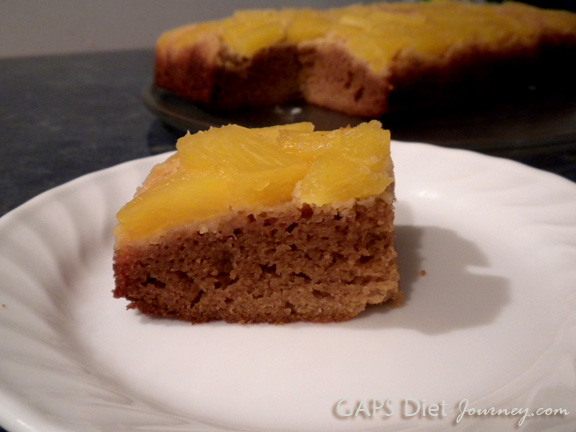
    I considered dehydrating but then decided to try making cake. One of my favorites, as a matter of fact… Pineapple Upside-Down Cake! The texture of this cake is very light, considering it uses coconut flour [affiliate link] and was really very delicious!

    Baker's Dozen Sweet Quick Breads

    Pineapple Upside-Down Cake

    • 3/4 cup honey [affiliate link], divided use
    • 13 ounces (about 2 cups) pineapple, in pieces
    • 1 cup coconut flour
    • 1 cup butter, room temperature
    • 1 teaspoon vanilla [affiliate link]
    • 1 teaspoon sea salt [affiliate link]
    • 1 teaspoon baking soda [affiliate link]
    • 6 eggs [affiliate link]
    1. Preheat oven to 325°F.
    2. Heavily grease a 11 x 7 Glass Baking Dish.
    3. Layer in the pineapple pieces. Drizzle 1/4 cup of honey over the top.
    4. Add the rest of the ingredients into a bowl and mix thoroughly using a mixer.
    5. Allow batter to sit five minutes so that coconut flour can absorb. Carefully spread batter over the top of the pineapple.
    6. Bake 25 minutes, then cover the top of the cake with a piece of aluminum foil as it will begin to darken.
    7. Bake another 15 minutes.
    8. A toothpick inserted will come out clean when done. Also, if you slighty jiggle the cake it will be remain still when done.
    9. Allow cake to cool in the baking dish for 20 minutes, then place a cookie sheet or cutting board over the dish and flip the cake upside-down.

    Pineapple Upside-Down Cake

    Pineapple Upside-Down Cake

    Pineapple Upside-Down Cake

    Pineapple Upside-Down Cake

    Pineapple Upside-Down Cake

    Pineapple Upside-Down Cake

    This cake will be plenty sweet if you are accustomed to the GAPS Diet. You may wish to drizzle additional honey on individual servings if you are serving to people who are used to a sweeter taste.

    Pineapple Upside Down Cake Made with Coconut Flour and Honey GAPS Legal
    Author: 
    Prep time: 
    Cook time: 
    Total time: 
    Serves: 24
     
    GAPS Legal Pineapple Upside Down Cake that will please any crowd.
    Ingredients
    • ¾ cup honey, divided use
    • 13 ounces (about 2 cups) pineapple, in pieces
    • 1 cup coconut flour
    • 1 cup butter, room temperature
    • 1 teaspoon vanilla
    • 1 teaspoon sea salt
    • 1 teaspoon baking soda
    • 6 eggs
    Instructions
    1. Preheat oven to 325°F.
    2. Heavily grease a 11″ x 7″ glass baking dish.
    3. Layer in the pineapple pieces.
    4. Drizzle ¼ cup of honey over the top.
    5. Add the rest of the ingredients into a bowl and whisk thoroughly using a mixer.
    6. Allow batter to sit five minutes so that coconut flour can absorb.
    7. Spread over the top of the pineapple.
    8. After 25 minutes, cover the top of the cake with a piece of aluminum foil as it will begin to darken.
    9. Bake an additional 15 minutes.
    10. A toothpick inserted will come out clean when done. Also, when not quite done the center of the cake will jiggle. At that point you can turn the oven off and leave the cake in the oven 5 minutes to finish baking.
    Nutrition Information
    Serving size: 1 Calories: 138 Fat: 10 Carbohydrates: 12 Fiber: 2 Protein: 2

    Click here to visit my sales site to get your copy of Baker’s Dozen Sweet Quick Breads

    Baker's Dozen Sweet Quick Breads


    GAPS DIET JOURNEY is a participant in the Amazon Services LLC Associates Program, an affiliate advertising program designed to provide a means for sites to earn advertising fees by advertising and linking to AMAZON.COM. GAPS DIET JOURNEY is an affiliate for several companies and may be compensated through advertising and marketing channels. Therefore, this post may contain affiliate links.

  • Do I Drink Bone Broth on the GAPS Diet?

    Do I Drink Bone Broth on the GAPS Diet?

    Bone broth has become wildly popular, and there are even places where you can buy a mug of bone broth to go. Kind of wild when you think about it!

    Because of this surge in popularity, I am seeing many people coming to GAPS believing they will be making and drinking bone broth. However, according to the founder of the GAPS Diet, Dr. Natasha Campbell-McBride, there is a difference and she has instructed us to make meat stock at the beginning of the GAPS Diet, especially during Introduction.

    So to answer the question… yes, you will drink bone broth on the GAPS Diet since Dr. Natasha does state in her Frequently Asked Questions page that bone broth may be used and is beneficial, but you’ll want to wait until later on in the diet.

    Here are some of the differences:

    • Meat stock is cooked with plenty of raw meat on the bone, while bone broth uses “meaty” bones or even previously cooked bones.
    • Meat stock is cooked for 2-3 hours until the meat is tender enough to eat while bone broth requires a much longer period of cooking – anywhere from 4 hours to 24 hours or longer.
    • Bone broth calls for vinegar to help leach minerals from the bones (vinegar not required for meat stock).

    Meat stock is easy to make. All you really need is meat, bones and water. You can add a few more nutrients and flavor by adding some vegetables like onions [affiliate link], garlic, carrots and celery.

    Here is a simple meat stock recipe to get you started.

    Simple Chicken Stock

    • 1 whole chicken, 4 to 5 pounds
    • 8 cups water
    • 1 teaspoon sea salt [affiliate link]
    • 1 teaspoon whole black peppercorns, roughly crushed
    • 1 onion, quartered
    • 2 carrots, cut into one inch chunks
    • 1 ribs celery
    • 4 cloves [affiliate link] garlic, chopped
    • 1 sprig parsley [affiliate link] or 1 teaspoon dried parsley
    1. Put everything into a pot that is large enough to hold all the ingedients.
    2. Bring to a boil, then reduce heat until the liquid simmers gently.
    3. Cook for 2-3 hours until the chicken is falling off the bones.
    4. Remove the vegetables and meat, strain the broth.

    You can use the vegetables and meat to make soup, chicken salad or just have the meat and vegetables with some butter slathered on top.

    I have personally experienced quite a number of changes to the way my body feels I feel by making sure to drink broth on a regular basis. When I fall out of the routine of drinking broth, I always end up feeling various aches and pains which vanish once within a few days of consuming broth daily.

    As my sister said to me recently, “Making broth is one more task but any bother is negated by living pain-free.” I have gotten into the habit of making broth each weekend and then make sure to have one cup each day. I might have it by itself, or in soup, or just poured over vegetables.

    What about you? Do you drink broth regularly? What is your favorite broth? Have you done the GAPS Diet? I would love to hear from you in the comments.

    Do I Drink Bone Broth on the GAPS Diet?
    Author: 
    Prep time: 
    Cook time: 
    Total time: 
    Serves: 8 cups
     
    Easy chicken meat stock recipe, suitable for Gut and Psychology Syndrome Diet.
    Ingredients
    • 1 whole chicken
    • 12 cups water
    • Unprocessed salt to your taste
    • 1 teaspoon whole black peppercorns, roughly crushed
    Instructions
    1. Put everything into a pot that is large enough to hold all the ingedients.
    2. Bring to a boil, then reduce heat until the liquid simmers gently.
    3. Cook for 2-3 hours until the chicken is falling off the bones.
    4. Remove the vegetables and meat, strain the broth.


    GAPS DIET JOURNEY is a participant in the Amazon Services LLC Associates Program, an affiliate advertising program designed to provide a means for sites to earn advertising fees by advertising and linking to AMAZON.COM. GAPS DIET JOURNEY is an affiliate for several companies and may be compensated through advertising and marketing channels. Therefore, this post may contain affiliate links.

  • Easiest Cauliflower Pizza Crust …Streamlined No Steaming Required!…

    Chard Asparagus Cauliflower Pizza Crust

    One of the most popular posts here at GAPS Diet Journey is the Cauliflower Crust Pizza post. However, I have some exciting news to report. Some time ago I learned that it’s not necessary to steam the cauliflower! My husband is the one that figured this out and I was so happy because the original recipe was a time-consuming process. Having to steam the cauliflower, then the added step of having to wring the moisture out of the cauliflower, and the burning of the hands.

    It was definitely worth the extra work but now that I know different I thought I would share with you my brand new updated, streamlined recipe.

    Before we get started, I have a few things to mention:

    1. You must have parchment paper or a silicone pizza mat for this recipe.
    2. Do not attempt to use parchment paper a second time. Well, you could if you were desperate but just know that the parchment paper will get really soggy and your crust may stick to it the second time around.
    3. You do not have to use Swiss Chard, you could substitute spinach or similar leafy green or you could omit it altogether.
    4. Feel free to omit the asparagus. This recipe works perfectly fine with only cauliflower, but I thought I would “adult” it up a little.

    Chard Asparagus Cauliflower Crust

    • 1 head of cauliflower (mine weighed 2 pounds 3 ounces with the leaves intact; 1 pounds 2 ounces without leaves; 5 cups shredded and packed)
    • 4 ounces Swiss chard or similar leafy green, optional
    • 2 ounces asparagus tips, optional
    • 4 eggs [affiliate link]
    • 1/4 teaspoon black pepper [affiliate link]
    • 1/4 teaspoon granulated garlic
    • 1/2 teaspoon sea salt [affiliate link]
    1. Preheat oven to 350°F.
    2. Place parchment paper on a pizza pan. Lightly grease with butter or bacon grease.
    3. Remove the outer leaves from the cauliflower, then wash.
    4. Shred the cauliflower. I find it is easiest to do this using a food processor. Break the head into small pieces for ease into feeding through the shoot.
    5. Remove the stems from the Swiss chard, cut into small pieces.
    6. Cut two inches of the top of a bunch of asparagus, then cut into 1/2″ pieces.
    7. Add these ingredients to a large bowl for mixing.
    8. In a smaller bowl, add the four eggs.
    9. Whisk, then add the pepper, garlic and salt.
    10. Pour over the cauliflower mixture.
    11. Mix together.
    12. Remove half the ingredients to the pizza pan.
    13. Press and form the vegetables into a flat, round shape.
    14. Be sure to press firmly so that the crust holds together.
    15. Place in the oven to bake for 30 minutes.
    16. Remove and flip the crust to the other side.
    17. Bake 25-30 minutes longer.

    The crust should hold together perfectly.

    Add your favorite ingredients to the top. My favorite sauce is my Italian Sausage Hamburger Pizza Sauce (no Italian sausage required).

    We usually don’t use cheese, but remember there are a few kinds of cheese you can eat if you’re doing the GAPS Diet and those are:

    Here is a picture of the ingredients mixed together, before adding the egg.

    Cauliflower Crust Pizza

    Here is a photo of the crust before it was baked, notice how it is pressed together firmly and holding its shape.

    Cauliflower Crust Pizza

    If you are looking for more Grain-Free and Dairy-Free recipes, I have a cookbook you need to get right now: Beyond Grain & Dairy.

    And if you love snacks, Gluten-Free Snacks has 34 gluten-free snacks, 24 of which are GAPS legal! Get yours today!

    Gluten-Free Snacks Community Cookbook

    Easiest Cauliflower Pizza Crust (Streamlined No Steaming Required!)
    Author: 
     
    Ingredients
    • 1 head of cauliflower (mine weight 2 pounds 3 ounces with the leaves intact)
    • 4 ounces Swiss chard or similar leafy green, optional
    • 2 ounces asparagus tips, optional
    • 4 eggs
    • ¼ teaspoon black pepper
    • ¼ teaspoon granulated garlic
    • ½ teaspoon sea salt
    Instructions
    1. Preheat oven to 350°F.
    2. Place parchment paper on a pizza pan. Lightly grease with butter or bacon grease.
    3. Remove the outer leaves from the cauliflower, then wash.
    4. Shred the cauliflower. I find it is easiest to do this using a food processor. Break the head into small pieces for ease into feeding through the shoot.
    5. Remove the stems from the Swiss chard, cut into small pieces.
    6. Cut two inches of the top of a bunch of asparagus, then cut into ½” pieces.
    7. Add these ingredients to a large bowl for mixing.
    8. In a smaller bowl, add the four eggs.
    9. Whisk, then add the pepper, garlic and salt.
    10. Pour over the cauliflower mixture.
    11. Mix together.
    12. Remove half the ingredients to the pizza pan.
    13. Press and form the vegetables into a flat, round shape.
    14. Be sure to press firmly so that the crust holds together.
    15. Place in the oven to bake for 30 minutes.
    16. Remove and flip the crust to the other side.
    17. Bake 25-30 minutes longer.


    GAPS DIET JOURNEY is a participant in the Amazon Services LLC Associates Program, an affiliate advertising program designed to provide a means for sites to earn advertising fees by advertising and linking to AMAZON.COM. GAPS DIET JOURNEY is an affiliate for several companies and may be compensated through advertising and marketing channels. Therefore, this post may contain affiliate links.

  • Why I Finally Started Meditating and How It Helps

    Why I Finally Started Meditating and How It Helps

    Meditation Calm Lake

    I avoided meditating or even the idea of meditating for a long, long time. Decades.

    Then in January one of my son’s mentors recommended that he implement meditation to help manage work-related stress.

    I encounter a great deal of stress in my job as well, and January and February were packed with stress in my home life. I won’t go into the details, except to share that I got sick and my asthma symptoms came back in full force, my husband got sick (he rarely gets sick), our elderly (“heart”) dog started to fail and eventually passed, and I had a dental cleaning scheduled. Don’t laugh, going to the dentist has become a very difficult task and I was determined to follow through with this recent appointment since I’d made and cancelled several during 2017.

    When my son told me he was going to start meditating, I decided to take a closer look. One of the reasons I’ve avoided meditating is because of my faith in Jesus Christ. My understanding is that meditation derives from Eastern religions and should be avoided. I have spent the last thirty years working to unlearn the damaging beliefs I was taught in the Pentecostal religion for the first two decades of my life. My son is also a believer but he was not exposed to the cult-like churches that I was as a child, so he is in a much better place with regards to religion. By the way, our family considers ourselves to be mid-Acts Dispensationalists, if you are curious.

    I decided to mention the religious aspect in this post because I shared a simple breathing technique with my mother. She experiences a lot of anxiety from projecting worst case scenarios and I felt it could help her to quiet her mind since it has worked well for me. Not five minutes later she met up with a friend of hers and asked me to share. The friend shot the technique down while looking me in the eye and said, “I used to meditate 20 years ago, but then I became a Christian.”

    Ugh. Thankfully I was able to respond that I was also using an app called Abide, which is specifically for Christians. Still, that got me all nervous that I was doing something “wrong”. Uh-oh, gonna get struck down!

    So I had a conversation with my sister, who told me about Calm, the app which she has been using for the last year. Obviously being raised in the same home, she was exposed to the same damaging control issues surrounding religion. She pointed out that the Calm app is not oriented to any religion and due to the 7-Day programs it is very similar to having a brief cognitive therapy session each day.

    I’ve been meditating every day using the Calm app for 48 days. I started on January 30th and have gone through several of the 7-Day programs. I usually meditate first thing in the morning, I don’t even get out of bed, I just lay on my back with my earbuds and listen and breathe. The sessions run from 11-13 minutes and I find Tamara Levitt’s voice to be extremely soothing. Tamara had a rough start in life, and meditation helped her turn things around. You can read her story here at the Calm blog: Tamara Levitt – Head of Mindfulness.

    By the way, much of the Calm app is locked unless you pay for a subscription but I like the 7-Day programs so much that I feel it is a valuable investment. I pay for the annual subscription which is currently $59.99. I can’t really recommend any other meditation apps as this is the only one I’ve used regularly. 

    I am feeling a great deal calmer, and more in control of my life. Things don’t seem so bad. Honestly, they weren’t that bad to start with! My life is good, but when my mind is racing from one negative issue to the next or I can’t get to sleep because of thoughts (THOUGHTS… just mere thoughts, not reality!!) or I feel anxious because of the worry it is hard to realize how good my life truly is.

    Here are some of the ways that meditation has helped me in the past few weeks.

    How Meditation Helps

    Stop the mind from racing

    It is normal for our minds to project the worst so focus on the process of breathing in and out to stop thoughts.

    In one of the 7-Day programs – I think it was the 7 Days of Calming Anxiety – Tamara says that we tend to imagine every worst case scenario because we think we can control the future by projecting. But a great deal of the time, those terrible things we imagine rarely or in many cases never happen so we spend a lot of time playing this sinister “what-if” game which tends to create a great deal of fear and negativity which leads to anxiety.

    I have learned it is very effective to focus on breathing. In and out. In and out. I know it sounds too simple, it did to me also. It is harder than you would think to just focus on your breathing and it does take practice to master this simple technique. It is very much like exercising a muscle. Sometimes as I breathe in and out, I think with each inhalation and exhalation: “In. Out. In. Out.” Sometimes I think, “Thank you. Jesus. Thank you. Jesus.”

    Understand that it is normal for the mind to wander onto other topics, while focusing on breathing. During the meditation session, Tamara reminds us that this is normal and to not be hard on yourself, but gently pull your mind back to focusing on your breathing every time you realize it’s happened.

    It takes a practice to master and it’s worth the effort. I was very glad to learn that it is normal for the mind to wander because I thought I was doing something wrong, or that my mind is different than anyone else.

    Helps with Getting to Sleep

    Does your mind decide it’s time to worry about everything when you’re trying to fall to sleep?

    Maybe your mind awakes you in the middle of the night, like mine tends to do.

    “Oh, were you sleeping? Wake up! It’s time to worry about that upcoming appointment or how to get everything done at work, or maybe the roof needs repair because it might rain, or I’m AWAKE, not sleeping, tomorrow is going to be so hard without enough sleep” and on and on and on.

    It has been a game-changer for me to start to focus on my breathing as soon as I realize my mind wants to race from one stressful thought to the next.

    It really works! My husband is one that if he can’t sleep he’ll just get up and stay up until the next night. One night he was restless and moving about and I told him about focusing on his breath and he fell asleep shortly after. The next morning he told me he’d never known that just focusing on one’s breath could help you fall asleep.

    Time Slows Down

    Does it seem like time is racing by for you? The weekdays zoom by and then it’s the weekend. Saturday and Sunday are over so fast, did you get anything done?

    This has been a complaint of mine in the past few years. It seems like my life is racing by so fast that I don’t know where the time has gone. Everyone says this is normal, this speeding up of time but I think I’ve figured out how to slow things down.

    After about five weeks of meditating, plus the use of another app called Fabulous it feels like my time has slowed, or at least my perception of time has slowed down.

    The weekends are now enjoyable as it feels like they leisurely drift along. Before it felt like hours would pass without my knowledge and I was scrambling every minute struggling to stay on top of things, but not really getting much done.

    That’s just a few of the benefits I’ve personally noticed from meditating. Do you meditate? What are your thoughts and what benefits have you noticed? I would love to hear from you in the comments. 


    GAPS DIET JOURNEY is a participant in the Amazon Services LLC Associates Program, an affiliate advertising program designed to provide a means for sites to earn advertising fees by advertising and linking to AMAZON.COM. GAPS DIET JOURNEY is an affiliate for several companies and may be compensated through advertising and marketing channels. Therefore, this post may contain affiliate links.

  • Gum Disease Can Happen Even If you Brush and Floss Daily

    Gum Disease Can Happen Even If you Brush and Floss Daily

    In my last post I admitted that I was shocked – and to be honest – disturbed by the dental hygienist’s announcement that I had gum disease. I thought since I was brushing and flossing regularly – meaning at least once a day and sometimes twice – that my gums should be great. But obviously that’s not the case! I’ve been doing a lot of research and there is a lot of information to digest.

    In the meantime, let me share what I’ve learned so far:

    If your hygienist finds bleeding when she probes your gums, and pockets deeper than 1 mm you’ve got gum disease. I think I can safely say your gum disease is in the first stages but you definitely want to start paying attention because healthy gums are tight against the teeth with a pocket measuring 1 mm or less, and there should be no bleeding when the gums are probed.

    I have mentioned this to a few people and the automatic response was of course there’s going to be blood, she just poked you with a sharp instrument. But what I’ve learned is that healthy gums should not bleed, and if they do, you have some degree of gum disease.

    Why is gum disease bad? Well, on a very basic level you’ve got an active infection in your mouth. Having an infection anywhere in your body is going to affect the way you feel. And I never really put this together, but did you ever realize that your oral health is directly related to your gut health? Dr. Tom O’Bryan is one of the speakers in the summit and his talk is entitled: Digestive Solutions: The Oral Gut-Health Connection. I will definitely be tuning in for this one (Day 4 March 15th Thursday).

    It seems to be generally accepted (in the “regular” dental world) that the pockets can be from 1 mm to 3 mm and as long as their is no bleeding, everything is just fine. However, Dr. Behm (a holistic dentist) states “In healthy gums, the depth of the sulcus is less than 1 mm. If the pockets exceed 1 mm it tells you and the hygienist that bacteria are getting the upper hand, entering the sulcus, attaching to the tooth and tissue forming a biofilm, a hard layer of protection around the bacterial colony.” Source: The Secret to Healthy Gums: How to Keep Your Teeth for the Rest of your Life.

    What are these pockets? The technical term is sulcus (the term Dr. Behm used above) and it’s the area between your gums and teeth. Ideally there is no gap there at all, but when there is, bacteria like to hang out there. One of the goals of brushing is to disrupt bacteria in this area at least once every 24 hours, otherwise they can begin to take hold and the pocket will grow bigger. My understanding is this all has something to do with the waste that the bacteria give off (so… these bacteria dudes are um… going potty in the sulcus?) And I’m realizing that it’s also important to get your teeth cleaned regularly, sorry to be the bearer of bad news. I totally get it. Remember I’m the one that doesn’t go to the dentist for 2, 3, 4, 5 years in a row? Ugh.

    I am going to be 55 this year, and never knew there was a proper way to brush one’s teeth. I’m going to link to this video again from OraWellness where Will is going to demonstrate the proper method.

    By the way, if you learn that your pockets are measuring over 1 mm you’ll need to do more than just brushing and disrupting the bacteria on a daily basis. With my newfound knowledge that the bacteria are toileting in my gums I guess this is like flushing the toilet… yeah… uh…

    Please do take a few minutes to jump over to Dr. Behm’s post: The Secret to Healthy Gums: How to Keep Your Teeth for the Rest of your Life

    In the past week, I have flossed and brushed morning and night, faithfully. I know it’s not enough though and I plan to incorporate The Secret again once I build up my stamina because it’s a commitment!

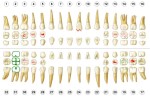
    In my last post, I shared that the hygienist said the improvement to my gum disease was remarkable. In that post I mentioned my progress but wanted to create a visual representation to show the comparison of improvement between the recent visit and the one from a year ago.

    There are six positions around each tooth on the gums where the hygienist checks (probes) for bleeding. Left, right and center at the front and back of each tooth.

    The image below indicates where my gums were healthy (not bleeding) vs. unhealthy (bleeding) for teeth 1 through 16 using red boxes with the letter “B” to indicate bleeding, with pink boxes and the letter “N” to indicate no blood.

    If you squint while looking at the image you can see that the bottom grid has much less red.

    Periodontal Chart Comparison

    57 positions with bleeding in 2017. 39 healthy.

    I have almost 50% less bleeding now with 30 positions bleeding, and 66 healthy.

    Next here is the grid showing the gum bleeding on teeth 17 to 32 (notice that it goes backwards as that is how the periodontal chart is laid out).

    58 positions with bleeding in 2017. 38 healthy.

    Currently only 33 positions are bleeding, with 63 healthy.

    I am determined the restore the health of my gums and I really want to reduce the depth of my pockets.

    If you are also interested in gum disease and what you should know and can do from a holistic point of view, the Holistic Oral Health Summit (it begins Monday March 12th and it’s completely FREE) features two speakers who will be talking about gum disease. Get registered and then mark your calendars:

    • Day 2 Tuesday March 13th – John Rothchild DDS – The Truth about Gum Disease
    • Day 3 Wednesday March 14th – Lane Freeman DDS – Gum Disease: Signs, Symptoms and Solutions
    • Day 4 Thursday March 15th – Dr. Tom O’Bryan – Digestive Solutions: The Oral Gut-Health Connection

    Each day there are five talks with five different experts and you can listen free throughout the day. On Day 8 of the summit, just in case you miss one of the talks, you will be able to listen to any of the talks.

    If you have to work, like me, you may want to consider buying the summit so that you can download all the talks and have unlimited access. That’s what I’m planning to do!

    If you are interested in oral health from a biological and holistic perspective please take a moment to register now so that you can take part in this free online event.

    The Oral Health Summit is COMPLETELY FREE for seven days. You’ll have the opportunity to glean current and innovative information from 35 of the best holistic Dental Health experts in the world.

    Register now to attend

    You’re going to learn about: 

    • Gum Disease
    • The connection between Oral Health and Cancer
    • Root Canals
    • Wisdom Teeth
    • Mercury Detox and Amalgam Removal
    • How to Have Great Oral Health
    • How to Find a Biological Dentist
    • Why You Should Avoid Regular Dentists and more!


    GAPS DIET JOURNEY is a participant in the Amazon Services LLC Associates Program, an affiliate advertising program designed to provide a means for sites to earn advertising fees by advertising and linking to AMAZON.COM. GAPS DIET JOURNEY is an affiliate for several companies and may be compensated through advertising and marketing channels. Therefore, this post may contain affiliate links.
  • My Hygienist said Gum Disease Improvement was Remarkable

    My Hygienist said Gum Disease Improvement was Remarkable

    She said it twice! At that moment I was finally able to relax a little.

    2017 – Gum Disease Diagnosis

    Last year on February 21st the dental hygienist kept nothing to herself as she cleaned my teeth. By the time she was done I was a nervous wreck.

    I hadn’t had my teeth cleaned for a few years and she informed me in no uncertain terms that I had gum disease. This came as a shock since  I brush and floss regularly, some days morning and night. My routine is to first brush to remove food, then floss and brush again. I really thought that I was doing a great job. But apparently that is not the case… the periodontal examination revealed a lot of bleeding (of 192 position probed, 114 were bleeding – that’s over half at 59%) with pockets as deep as four and five. She recommended debridement to which I agreed; however, I declined the recommendation for deep scale cleaning as I have read that it can make things worse.

    It took a few days for me to recover from getting this news, but I knew the first place to visit was OraWellness.com. A few years ago they put together the HealThy Mouth Summit – which is when I first learned about them. I have been very impressed with their products and their website, they always offer amazing information about all things oral.

    OraWellness offers a product that is specifically designed to help reverse gum disease. I ordered one of the applicator kits,  more Healthy Mouth Blend oil and several more of their special Bass toothbrushes. One of the things I learned from OraWellness is that my brushing technique was wrong. Here is a video from OraWellness on how to brush your teeth correctly.

    I started to use the applicator kit once it arrived but it is a lengthy process, taking about 20 minutes to do the protocol. I am sorry to say that I stopped using it after about a dozen times. I did continue using the Healthy Mouth Blend oil. I had stopped using toothpaste much earlier because I learned that glycerin in toothpaste coats your teeth which prevents your teeth from remineralizing.

    In addition to using the Healthy Mouth Blend oil with the Bass toothbrush, I oil pulled, water pulled, and sometimes used a Sonicare toothbrush. At my recent appointment the hygienist says she likes the Sonicare and encouraged me to use it over manual brushing. 

    I also started the protocol called “The Secret” from holistic dentist Dr. Behm who is located in Florida. Dr. Behm says this protocol can reverse gum disease and help you keep your teeth for your whole life. 

    There are three steps to Dr. Behm’s protocol and I only got so far as the toothbrush which is Tool #1 and floss, which is actually Tool #3. Although I purchased Tool #2 I never incorporated it and in reading the protocol again it is pretty important!! Tool #2 is the Butler Rubber Tip Gum Stimulator. Dr. Behm also recommends use of water irrigation as Tool #4, if you can afford it.

    For several months I kept a gum healing protocol chart on the wall in the bathroom so I could mark off every little box of what I was doing to help improve my gums. Feel free to download a copy if you would like to track your gum healing progress.

    And the last thing I want to mention which I believe played a part in my gums improving was drinking broth almost every day of 2017. Last year I hosted five broth challenges and estimate that I drank broth 300 days out of the whole year.

    Dr. Alison Siebecker in her article Traditional Bone Broth in Modern Health and Disease Townsend Letter states: “Calcium (broth) can be considered for use in the following deficiency signs, symptoms and conditions: pain and inflammation, cramps, muscle spasms, delusions, depression, insomnia, irritability, hyperactivity, anxiety, palpitations, hypertension, high cholesterol, allergies, brittle nails, periodontal and dental disease, pica, rickets, osteomalacia, osteoporosis and any situation that creates bone loss such as aging, immobilization, post-menopause, and caffeine, tobacco, and alcohol use.”


    I had planned to go back and have my teeth cleaned at the 3-month mark (May 2017), but every time I made an appointment I totally chickened out. Finally in November I told the office to call me back in January and I would schedule an appointment for February to get my teeth cleaned.

    Try to think of something special that you can do afterwards to put a positive spin on your visit.

    I was still feeling nervous about going to the appointment so two weeks prior I decided I needed to find some way to reward myself for keeping my appointment. An online friend had moved from California to Arizona about 3 years ago but we had never actually gotten together in person, so I sent her a message to see if she she was available to meet up. She was, yay!

    2018 Cleaning Appointment

    Back to my cleaning appointment… After a few minutes the hygienist asked if I had been to a different office to have my teeth cleaned and how long it had been since my last cleaning? Ironically it had been one year to the day and I confirmed that I had not been to a different office. That was when she told me that my gums had improved and it was remarkable how much better they were especially considering that I hadn’t had a cleaning for a year.

    I breathed a huge sigh of relief and told her that I was so thankful because I had been working very hard to improve the condition of my gums. She said that I did still have some bleeding, but overall there had been remarkable improvement.

    I asked for my new periodontal charting so that I could compare it with the 2017 cleaning. Before my appointment I was freaked out that there would be no improvement or that my gums had gotten worse.

    When I compared the two, I was disappointed to see that most of my pockets were the same, a few had gotten better and a couple were worse. But more importantly the bleeding had improved and that means less inflammation and gum disease.

    At the 2017 appointment out of 192 positions (32 teeth times 6 positions), 114 were bleeding (59%). This time there were only 64, down to 33%. That’s pretty good, or shall I say remarkable! 🙂

    I did not know until I started doing some research that it is generally accepted that pockets with depths of 1 mm to 3 mm with no bleeding are not considered to be a problem. However, please note that Dr. Behm states, “In healthy gums, the depth of the sulcus is less than 1 mm. If the pockets exceed 1 mm it tells you and the hygienist that bacteria are getting the upper hand, entering the sulcus, attaching to the tooth and tissue forming a biofilm, a hard layer of protection around the bacterial colony.” Source: The Secret to Healthy Gums: How to Keep Your Teeth for the Rest of your Life.

    From my understanding of reading about Dr. Behm’s protocol, it is possible to reduce the depth of the pockets, so I am definitely going to be working more on using his protocol.

    To summarize what I did over the last year:


    GAPS DIET JOURNEY is a participant in the Amazon Services LLC Associates Program, an affiliate advertising program designed to provide a means for sites to earn advertising fees by advertising and linking to AMAZON.COM. GAPS DIET JOURNEY is an affiliate for several companies and may be compensated through advertising and marketing channels. Therefore, this post may contain affiliate links.