GAPS Diet Journey Logo

Blog

  • Garden Art

    Garden Art

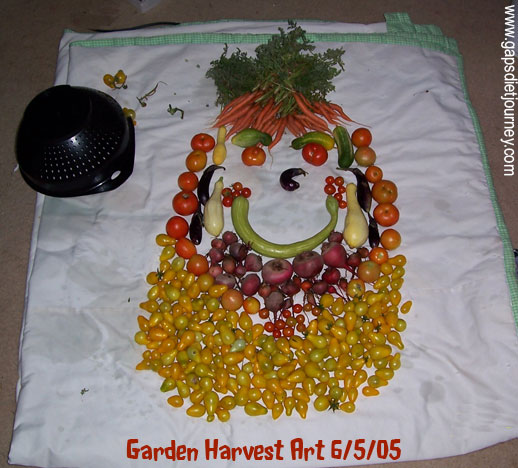
    Garden Harvest Art from June 5, 2005
    Yellow pear tomatoes,red beets, gold beets, red tomatoes, carrots, zucchini squash, pickling cucumbers, yellow crookneck squash, yellow tomatoes, eggplant, Zucchetta Ramp Tromboncino Squash (the long curved mouth).
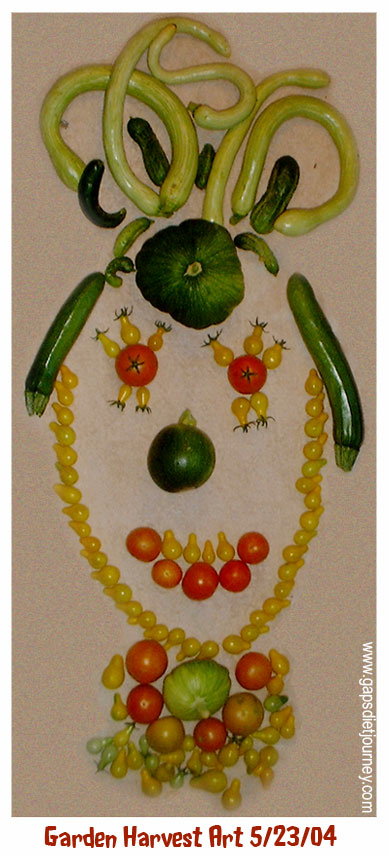
    Garden Harvest Art from May 23, 2004
    Zucchetta Ramp Tromboncino Squash (the curvy hair), pickling cucumbers, red tomatoes, yellow pear tomatoes, zucchini squash.


    Just a very quick post today with two of my favorite gardening photos. I am hoping I will have enough energy to have a garden this fall which is the best gardening season for Arizona. Cool winter gardening means spinach, Swiss chard, onions [affiliate link], radishes, beets, carrots, cabbage and many more that I can’t remember off the top of my head.

    My favorite place to buy seeds is from Pinetree Seeds. I love poring over their seed catalog and reading all the wonderful descriptions.

    I typically do square foot gardening, and my favorite book on this subject is by Duane Newcomb: The Backyard Vegetable Factory: Super Yields from Small Spaces. I like this book better than the other famous square foot gardening guy because I cannot follow much of that guy’s books because we are in Arizona and just can’t follow the same ideas.

    Mr. Newcomb’s book helped me to have my first successful garden – before that I thought I had a black thumb!

    So typically I do not have huge harvests throughout the season, but as the end of the season nears and the temperatures begin to rise as the summer approaches, I will harvest everything I can find in the garden and put together some garden art as you can see in the two photos above.

    I do great the first three seasons (fall, winter and spring) but by the time the next season rolls around the critters are all highly aware that I have a garden going and even though my garden looks like Fort Knox they find a way in and attack my vegetables. It is so frustrating and such hard work that I give up easily since I don’t have enough energy to fight them. It is mostly gophers and round tailed ground squirrels.

    Here is a video of round tailed ground squirrels, they are cute little buggers.

    Do you garden? What kinds of critters plague your area?

    GAPS DIET JOURNEY is a participant in the Amazon Services LLC Associates Program, an affiliate advertising program designed to provide a means for sites to earn advertising fees by advertising and linking to AMAZON.COM. GAPS DIET JOURNEY is an affiliate for several companies and may be compensated through advertising and marketing channels. Therefore, this post may contain affiliate links.


  • Lettuce for Lettuce Wraps

    Lettuce for Lettuce Wraps

    Bacon, Lettuce, Tomato and Avocado Sandwich

    I remember before I started on the GAPS Diet I used to hear about people eating hamburgers with lettuce leaves wrapped around them and I remember thinking that I would never do that. Why would I? I had “regular” hamburgers buns to eat, gosh darn it!

    And then I started on GAPS, and my relationship with food changed dramatically. It’s amazing to me but my mouth waters at the thought of a lettuce wrapped burger. Especially one with some bacon grease or lard drizzled on top of the burger fixins if you don’t have homemade mayonnaise on hand.

    You can use romaine lettuce, or green or red leaf lettuce for wraps, burger or even tacos and they are very easy to pluck away.

    I like using iceberg because it has less flavor and if you prepare the leaves and let them sit out for a few hours until they become kind of wilted, they work even better. At least I that’s my preference.

    The only problem when you’re using iceberg lettuce is the leaves are often hard to remove. I have had times where I removed half of the leaves to get 3 or 4 intact leaves. One day I had a brainstorm. I decided to ask the cook at my job if she had any ideas on how to remove the lettuce leaves any easier than the way I’d been trying it. She’s been in the food industry for over 20 years and she told me to use water to help the leaves fall away from the head.

    So I went home and tried it. It worked great and I’ve been doing it this way ever since!

    Here is a video I put together which shows exactly how it works.


    And here are some written instructions, in case you don’t have 2 minutes to check out the video. 🙂

    1. Cut around the core with a knife, and bang the core against a hard surface. This will allow you to easily remove the core.
    2. Remove any leaves that are blemished before starting.
    3. Place a strainer in the sink to catch the leaves as they fall from the head.
    4. Find the outermost leaf and begin working there.
    5. Turn on the water, and lightly pull the stem of that lettuce leaf back to where the stream of water can flow down in between the outermost leaf and the next leaf.
    6. As the water streams in between the leaves, the outermost leaf will grow heavy and will fall away from the head. Assist this falling away by cradling the head of lettuce with your hand so that you control the movement of the lettuce leaf. You increase your chances of more intact and useable leaves in this way.
    7. Find the next outermost leaf and follow the same process.
    8. Place a burger, or a dollop of chicken salad, or bacon, lettuce, tomato and avocado on the lettuce leaf. Fold the stem part over the food, then tuck the left and right sides in and finish by folding the burger onto itself to end up with a completely wrapped sandwich.
    9. Garnish, if desired.
    10. Enjoy!

    I would love to hear from you in the comments if you’ve had this same problem, and if my solution has been helpful. Thanks!! Starlene

    Bacon, Tomato, Lettuce and Avocado Sandwich

    GAPS DIET JOURNEY is a participant in the Amazon Services LLC Associates Program, an affiliate advertising program designed to provide a means for sites to earn advertising fees by advertising and linking to AMAZON.COM. GAPS DIET JOURNEY is an affiliate for several companies and may be compensated through advertising and marketing channels. Therefore, this post may contain affiliate links.
  • Cherry Cheesecake Ice Cream Dairy-Free

    Cherry Cheesecake Ice Cream Dairy-Free

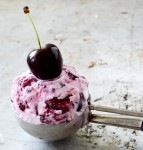
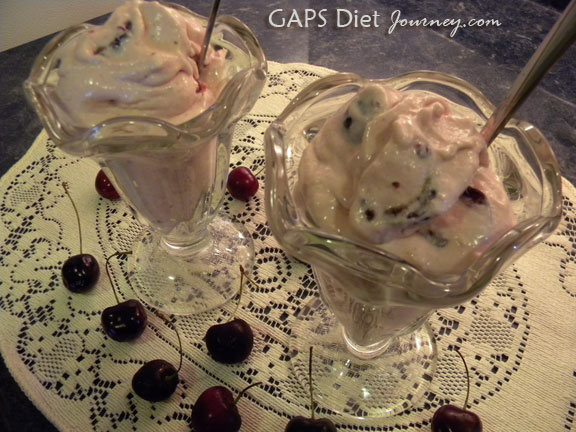
    Cherry Cheesecake Ice Cream

    First off, let’s be clear that GAPS allows fermented or aged dairy products. I went off dairy (including butter!) for six weeks when I did Introduction for the first time and when I’ve tried to re-introduce, it kicked up some respiratory symptoms for me with which I was unwilling to live, so I’ve decided to stay off of dairy (although I seem to tolerate butter and ghee okay). If you are doing GAPS, I’m sure it would work out great if you substituted the coconut cream [affiliate link] and creamed cashews with equal parts of yogurt made from cream, or kefir made from cream. I used Natural Value Coconut Milk, it has no illegal GAPS additives (like guar gum) and the cans are not BPA-free now BPA-Free! Yay! I love this product.

    I was very pleased that this ice cream was not rock hard after freezing for 24 hours. I was still able to use an ice cream scoop to remove a serving. I believe that is due to the high fat content from using the coconut cream.

    • 1 cup raw cashews, soaked overnight
    • 32 sweet black cherries, pitted and cut in half
    • 6 egg yolks
    • 1/2 cup (preferably raw) honey*
    • 6 T. freshly squeezed lime juice
    • 1-1/4 cup cream of coconut milk [affiliate link], harvested from 2 cans full fat coconut milk – (the cream that rises to the top of canned coconut)
    • 1 teaspoon vanilla [affiliate link]

    If you have an ice cream maker like mine, the Donvier Chillfast 1 Quart Ice Cream Maker, make sure the insert is in the freezer for at least 7 hours prior to making ice cream. I like to keep the insert in the freezer at all times so that I can make ice cream if the urge strikes.

    Refrigerate the coconut milk overnight so that the cream can solidify and is cold when you make the ice cream.

    Soak 1 cup of raw cashews with 1/2 teaspoon sea salt [affiliate link] overnight.

    Drain the liquid from the cashews and place in the refrigerator to chill while preparing the other ingredients.

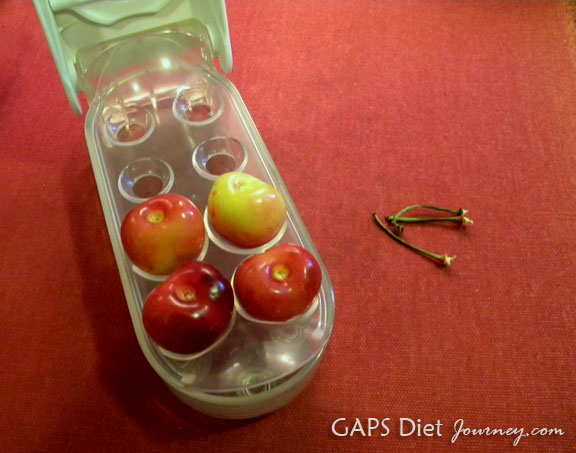
    Pit 32 cherries and cut them in half. My favorite device is the Progressive International GPC-5000 Cherry-It Multiple Cherry Pitter which I recently reviewed.

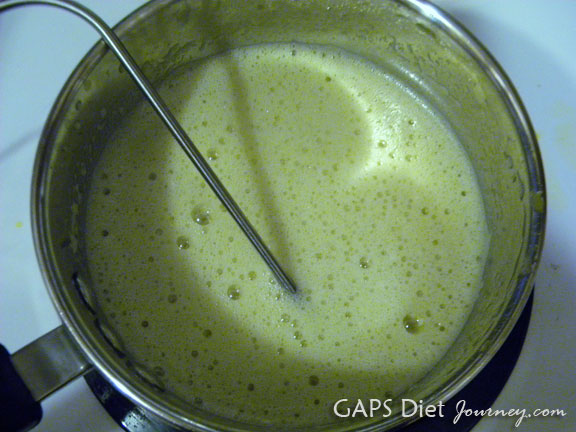
    Place the egg yolks, 1/2 cup honey [affiliate link] and 6 tablespoons freshly squeezed lime juice into a small saucepan. Stirring constantly, heat until simmering and cook until the temperature rises to exactly 170°F.

    Remove from heat. Place in the freezer and stir every ten minutes until chilled.

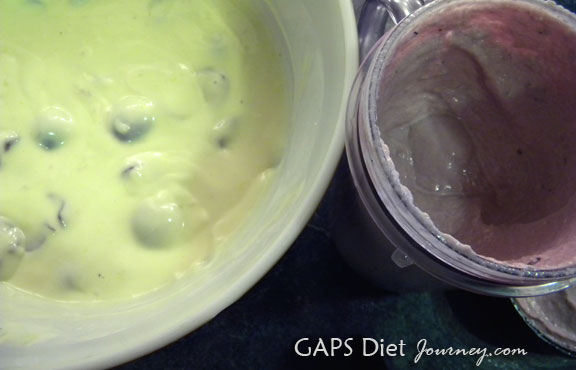
    Remove the soaked cashews from the refrigerator and place in a powerful blender with 8 of the cherries. I used my Magic Bullet which worked great. Blend the mixture until the cashews are completely smooth. If using a regular blender you may need to stop and stir, and with the Magic Bullet [affiliate link] I took the cup off and shook it, then blended for 30 seconds, several times. If the mixture is extremely thick, add 1 or 2 tablespoons of coconut water or just plain water if you are using cream yogurt or kefired cream.

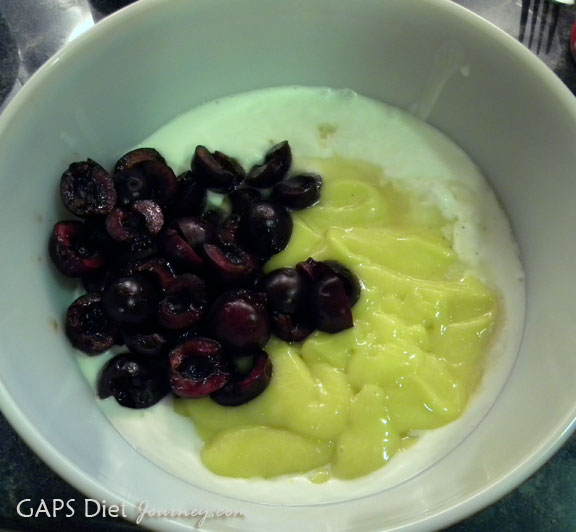
    When the lime and egg mixture is completely chilled, pour into a bowl and add the coconut cream and the remaining cherries. Add in the vanilla and stir. Add in the cashew cream and cherry mixture and stir.

    Place in the ice cream maker and stir until thickened.

    My husband said this was delicious, but he wished it had either chocolate or graham crackers in it. Matthew loved it and was happy with one 1/2 cup serving. It has a tart taste to it, and is not super sweet. It tastes like cheesecake filling to me.

    I hope you enjoy it, too! I would love to know if you get a chance to try it, please let me know.

    There is a printable recipe below.

    This recipe was shared at Fat Tuesday and at GAPS Friendly Fridays.

    Eggs, lime juice and honey heating to 170°F

    Eggs, lime juice and honey, chilled

    Cherry Cheesecake Ice Cream Ingredients

    Cherry Cheesecake Ice Cream Ingredients

    Cherry Cheesecake Ice Cream

    Cherry Cheesecake Ice Cream

    Cherry Cheesecake Ice Cream


    *If you order from Tropical Traditions by clicking on any of my Tropical Traditions links and are a brand new customer, you will receive this free book: Virgin Coconut Oil : How it Has Changed People’s Lives, and How it Can Change Yours, and I will receive a discount coupon for referring you. Thank you!


    Recipe: Cherry Cheesecake Ice Cream Dairy-Free
    Author: 
    Recipe type: Dessert
    Serves: 8
     
    Ingredients
    • 1 cup raw cashews, soaked overnight
    • 32 cherries, pitted and cut in half
    • 6 egg yolks
    • ½ cup honey
    • 6 T. freshly squeezed lime juice
    • 1-1/4 cup cream of coconut milk, harvested from 2 cans full fat coconut milk – (you are harvesting the cream that rises to the top of canned coconut)
    • 1 teaspoon vanilla
    Instructions
    1. Refrigerate the coconut milk overnight so that the cream can solidify and is cold when you make the ice cream.
    2. Soak 1 cup of raw cashews with ½ teaspoon sea salt overnight.
    3. Drain the liquid from the cashews and place in the refrigerator while preparing the other ingredients.
    4. Pit 32 cherries and cut them in half. My favorite device is the
    5. Progressive International GPC-5000 Cherry-It Multiple Cherry Pitter.
    6. Place the egg yolks, ½ cup honey and 6 tablespoons freshly squeezed lime juice into a small saucepan.
    7. Stirring constantly, heat until simmering and cook until the temperature rises to exactly 170°F.
    8. Remove from heat. Place in the freezer and stir every ten minutes until chilled.
    9. Remove the soaked cashews from the refrigerator and place in a powerful blender with 8 of the cherries. I used my Magic Bullet which worked great.
    10. Blend the mixture until the cashews are completely smooth. If using a regular blender you may need to stop and stir, and with the Magic Bullet I took the cup off and shook it, then blended for 30 seconds, several times.
    11. When the lime and egg mixture is completely chilled, pour into a bowl and add the coconut cream and the remaining cherries.
    12. Add in the vanilla and stir.
    13. Add in the cashew cream and cherry mixture and stir.
    14. Place in the ice cream maker and stir until thickened.
    Notes
    If you have an ice cream maker like mine, the Donvier Chillfast 1 Quart Ice Cream Maker, make sure the insert is in the freezer for at least 7 hours prior to making ice cream. I like to keep the insert in the freezer at all times so that I can make ice cream if the urge strikes. If you can have dairy products, feel free to substitute the coconut milk cream and cashews with yogurt made from cream or kefired cream.

    Save

    If you love desserts like this, I have two cookbooks you really need to check out ASAP! Everyone Loves Pudding and Naturally Sweetened Treats.

    GAPS DIET JOURNEY is a participant in the Amazon Services LLC Associates Program, an affiliate advertising program designed to provide a means for sites to earn advertising fees by advertising and linking to AMAZON.COM. GAPS DIET JOURNEY is an affiliate for several companies and may be compensated through advertising and marketing channels. Therefore, this post may contain affiliate links.
  • Review: Cherry Pitter

    Review: Cherry Pitter

    Rainier Cherries, Pitted

    It’s cherry season (somewhere – since I don’t think cherries actually grow in the Arizona desert) because they are on sale at many of the local grocery stores. My husband has brought home several pounds and they are huge and juicy and delicious.

    Matthew has been helping me to pit them using our Cherry Pitter.

    Here is the photo demonstration. First rinse your cherries.

    Whole Rainier Cherries

    Remove the stems. You will see there is a piece that lifts out of the cherry pitter. One end has four small cavities, while the other end has four larger cavities.

    Cherry Pitter Parts

    If your cherries are large, as were ours, position the insert so that the larger cavities are at the outer end of the cherry pitter. Insert your cherries as shown.

    Cherry Pitter

    Now here’s where it gets a little tricky. On the top part of the cherry pitter you must press the spring loaded piece and then lock it on the top. In this image you can see the locked and unlocked position. Please be aware that the pitter blades are quite sharp so watch your fingers as you hold it in to lock in place.

    Cherry Pitter Locked and Unlocked

    Cherry Pitter in Locked Position

    The cherry pitter is placed in the locked position while pressing down on the cherries. Then, while the lid is still down. unlock the device. The spring loaded piece then pops out and disengages the cherries from the sharp pitter blades.

    Here is a closeup of the top and bottom of the cherries, once pitted.

    Pitted Cherries

    Get yours at Amazon here: Cherry Pitter

    GAPS DIET JOURNEY is a participant in the Amazon Services LLC Associates Program, an affiliate advertising program designed to provide a means for sites to earn advertising fees by advertising and linking to AMAZON.COM. GAPS DIET JOURNEY is an affiliate for several companies and may be compensated through advertising and marketing channels. Therefore, this post may contain affiliate links.

  • Are You A Fat Burner or a Sugar Burner?

    Are You A Fat Burner or a Sugar Burner?

    Raw Cheesecake and Chocolate Cake with Butter Cream Frosting

    I enjoyed reading this article at Mark’s Daily Apple: What Does it Mean to Be Fat Adapted? Mark goes into detail answering the question, and then he says to ask yourself a few basic questions:

    1. Can you go three hours without eating? Is skipping a meal an exercise in futility and misery?
    2. Do you enjoy steady, even energy throughout the day?
    3. Are midday naps pleasurable indulgences, rather than necessary staples?
    4. Can you exercise without carb-loading? Have the headaches and brain fuzziness passed?

    I thought it was pretty cool that I seem to be a fat adapted… I can easily go 3 hours without eating. Nowadays I have my big protein breakfast, then bring a tin of sardines with me to have for lunch at work. Then I’m good until I get home, and that might be 7 or 8pm at night before I arrive home.

    I can easily skip a meal, which is amazing. I remember it was i.m.p.o.s.s.i.b.l.e. for me to skip a meal. I couldn’t even fathom or consider skipping a meal because I would get cranky, shaky and brain fogged.

    I do pretty much have steady energy throughout the day. I was thinking the other day how I don’t even consider getting coffee [affiliate link]. I have never really been able to drink coffee, but I would drink four ounces if I needed an energy boost, or if I didn’t get a good night’s sleep. I would also have times where I would almost fall asleep while driving. That was awful. I’d clap my hands in front of my face to try to wake myself up. I’d slap my cheeks in an effort to wake myself up. It is not safe driving at 70mph while nodding off!

    I used to have to take at least one and sometimes two naps on the days I’m at home. I don’t have to any longer.

    I never really did anything special before exercising, and I currently am not exercising since I’m trying to heal my adrenals. I don’t have brain fuzziness any longer.

    Food used to be a lot more important to me than it is now. I had to bring a food bag with me wherever I went. I used to bring leftovers from dinner, and I had to use the kitchen stove to heat my food, which took 5-10 minutes. Now I just pop my tin of sardines open, or open a package of nuts. It takes so much less time now.

    This is how it used to be for me:

    • Breakfast:  Yogurt or kefir shake, or two scrambled eggs [affiliate link], or broth with vegetables blended into a cream soup with a couple egg yolks.
    • Mid-morning snack:  Hunk of cheese, or nuts and a piece of fruit, or maybe a cup of yogurt.
    • Lunch: Leftovers from last night’s meal
    • Mid-afternoon snack for on the way home from work:  Piece of fruit, or nuts.

    Heaven help me if I got caught in traffic on the way home. Oh dear. I would be so ravenously hungry by the time I got home I would just stand at the stove and shovel food into my mouth. My husband used to cook dinner and it was always a buffet of carbohydrates… homemade baked macaroni and cheese, cornbread, peas, home baked bread, mashed potatoes and gravy, biscuits. I loved those foods, and he loved cooking them for me, because he knows how much I loved them.

    So now this is what it looks like for me:

    • 50 grams protein for breakfast. This might be 8 ounces of beef with a couple tablespoons butter, or chicken breast, chicken thighs, hamburger, pork chops or bacon. I try to remember to have a cup of broth with breakfast.
    • Lunch = 1 tin of sardines most often, sometimes I’ll have 1 ounce of sunflower seeds, cashews or almonds [affiliate link] (this is when I’m in a super hurry and forget to grab my tin of sardines, so have to go to the corner convenience store and buy something – I should just bring those tins of sardines with me and stash in my desk)
    • Dinner – whenever I get home, ideally before 7pm. I usually have about 6 ounces of meat with dinner, salad or vegetables on the side, ferments.

    Yesterday was a great demonstration of how it’s changed for me. I promised one of my coworkers that I would make to allergy-friendly desserts, which were both GAPS legal, for her birthday party. I don’t usually leave home on the weekends, if I can help it, but I wanted to attend her birthday party so I left home around 11am to head into town for the party.

    For breakfast around 6am I had half of a hot pork sausage link (about 4 ounces) and 5 slices of bacon. On the way out the door to the party I took 5 more pieces of bacon with me that were left from breakfast. When I got to the party I helped to set up, and got the desserts I’d brought cut and into the pretty little paper cups.

    While at the party, there were vegetables and fruit that I could have eaten, but instead I decided to eat some of the desserts I’d brought – I ate those around 2pm. After the party I did some grocery shopping for my youngest sister, who my mom told me was running short on food. I dropped by and dropped off the food, then headed to my mom’s house. I was only there a few minutes and then headed out to another errand. Then I decided to visit another sister.

    By the time we met up it was almost 9pm and she was going to Wet and Wild in north Phoenix. I used to go there every summer with my boys when they were younger and we lived in town. I would save money every month all year long to buy passes because it is actually affordable to visit those water parks when you do it that way. My last “meal” had been the desserts and I wasn’t really hungry. But I had my tin of sardines with me and I decided to eat them before we went into the water park. I did eat my sardines and I was fine with that for the rest of the night. My sister had brought salad with her and she ate salad before we went into the park, an hour later after we got out of the park, and around midnight when I was planning to leave she offered me a piece of grilled chicken breast. I wasn’t a bit hungry though, and I got home around 1:30am and still wasn’t hungry. I went to bed and I was fine.

    I was a little bit freaked out about being in the heavily chlorinated water, and the smell of chlorine was overpowering while in the water. I know it causes a toxic load on our bodies to be in swimming pools, but I go swimming about once a year if that, and I wanted to spend time with my sister and niece and grand nephew and it was fun playing and floating in the wave pool. Since I am on adrenal support I gave myself a “stress dose” before we went into the park, and then I felt a little sick to my stomach after we left so I administered another “stress dose”. The stomachache dissipated after about 15 minutes.

    I haven’t felt too bad today. I got a good night’s sleep and slept well.

    So what about you? Would you say you are fat adapted?


    GAPS DIET JOURNEY is a participant in the Amazon Services LLC Associates Program, an affiliate advertising program designed to provide a means for sites to earn advertising fees by advertising and linking to AMAZON.COM. GAPS DIET JOURNEY is an affiliate for several companies and may be compensated through advertising and marketing channels. Therefore, this post may contain affiliate links.

  • How to Rid Your Home of GAPS Illegal Foods

    How to Rid Your Home of GAPS Illegal Foods

    Foods not allowed on GAPS

    Hopefully your whole family is going on GAPS, because this will be the easiest for everyone concerned. If not I will share some ideas on how we have dealt with this problem.

    1. The first thing you should do is to print out the list of GAPS foods that are allowed, and GAPS foods to avoid. For a comprehensive list, refer to Dr. Natasha Campbell-McBride’s book Gut and Psychology Syndrome.
    2. Make sure you have on hand a garbage can with plastic bags, and several boxes.
    3. Some foods you will throw away, while others you can stack into the boxes and share with anyone you know who still eats these foods. You may even be able to share with a local food bank or church pantry. If you have chickens, you can share with them.
    4. Start at one section in your kitchen and go through each cupboard. Work clockwise around the room. As long as you are removing items, you may as well wipe out each cupboard. You will probably find that you now have a few empty cupboards available.
    5. Now go through your pantry, shelf by shelf.
    6. Don’t forget the refrigerator. Check condiment ingredient lists carefully.
    7. Go through the freezer as well.

    If the item has been opened, decide whether you will toss or maybe you know someone who won’t mind if the food has been opened. Food banks and churches will most likely refuse open products, but you may have friends, neighbors or family who won’t care one way or the other.

    Most processed foods will be leaving, some foods you will need to take a closer look at ingredients to see if they can be kept or should go. Most canned foods will be moved out. Anything containing grains or gluten, sugar or MSG, artificial colors, etc., is going to go.

    It will be easier on everyone if the foods you cannot eat are completely removed. This way there will be no temptation. It will be difficult enough leaving the house, but at least you will be safe in your home.

    What If The Whole Family Isn’t Going to do GAPS?

    I’ve been on GAPS since December 2009 but I’ve never been able to fully remove all GAPS illegals from our home. The reason is because my husband has not been fully on board, and our youngest son completely rejected the idea. I can’t blame him – I did preach to him throughout his whole life that he shouldn’t diet, he should not restrict anything or it would just cause cravings. I wish I had known what I know now and that is if you stop eating these foods altogether those cravings disappear.

    The whole time I’ve been on GAPS, our youngest son has continued to bring all GAPS illegals into the home, he has baked bread, made pancakes, pizza, rice, popcorn, and it has been interesting to have those smells around me and not be overcome with desire to eat them. I have even bought my son pizza at his request and brought it home smelling it all the way during a twenty minute ride home. But things changed last Tuesday. Our son flew out of the nest. I was completely unprepared for the emotional upheaval and heart break that I now know comes with having a child leave home.

    So here is what we did to share the kitchen. We already had two refrigerators, so our son kept his illegals in there. He was also designated two cupboards, the top of the refrigerator and another shelf to keep any items that the rest of us were not eating. This was kind of difficult sometimes, as I know that Matt would sometimes sneak food from the wrong refrigerator.

    You might even go so far as to put locks on cupboards or the refrigerator door if you have small children.

    I rarely hear of mothers unwilling to do GAPS with their children, and hear much more often about fathers that are unwilling to give up their old addictions favorites. One solution is for dad to eat GAPS meals while at home, but eat GAPS illegals at lunch time or outside the home.

    At first this may all seem overwhelming, and another option is to use the foods you have on hand but do not replace them as they are depleted.

    What Next?

    Now you will slowly begin to replace ingredients in your kitchen with ingredients that are GAPS legal. When I first started GAPS, I kept it simple. I made fermented foods, ate lots of soup and broth, meats, vegetables and plenty of healthy fats. But eventually I wanted to learn how to use coconut flour [affiliate link], almond flour [affiliate link] and other similar products, so I slowly began purchasing items. Tropical Traditions is a great resource for not only coconut products, but an amazing selection of products such as grass fed meats, soy free eggs [affiliate link], organic soy free chicken, organic raw honey [affiliate link], organic peanut butter [affiliate link], organic skin care products, non-toxic household cleaners and this is just a few of the products they carry. By the way, if you use my link and are a first time purchaser, you will receive the book called Virgin Coconut Oil [affiliate link]: How it has changed people’s lives and how it can change yours! completely free, and I will receive a discount coupon for referring you.

    Now I must get back into the kitchen to finish the job of clearing my cupboards of all GAPS illegals. 🙂


    GAPS DIET JOURNEY is a participant in the Amazon Services LLC Associates Program, an affiliate advertising program designed to provide a means for sites to earn advertising fees by advertising and linking to AMAZON.COM. GAPS DIET JOURNEY is an affiliate for several companies and may be compensated through advertising and marketing channels. Therefore, this post may contain affiliate links.